
Homedrift: Listeners Find a Haven in Local and Global Sounds
The mainstream has never felt more global. Just think of Karol G being the first Latina headliner at Coachella or the K-pop genre earning its first-ever Grammy and Oscar thanks to Kpop Demon Hunters. Just as mainstream entertainment is growing more international, so are audiences’ appetites for it. And in the face of increasing polarization over differences like race, citizenship, and gender, artists aren’t backing down—and fans are here for it. After all, 68% of listeners enjoy discovering music from artists rooted in different cultures.
In an increasingly fragmented cultural landscape, audiences switch between feeling grounded with traditions and feeling exploratory with global sounds. Some want to feel at home, like when someone leans into their AAPI roots by listening to Jennie’s album Ruby. And others may want to expand their horizons by listening to Rosalía’s LUX, which spans 13 languages and multiple genres. Meanwhile, some want to feel both. This tension is called Homedrift, one of the trends in the SiriusXM Media Culture Index.
Listeners are already embracing this movement, and here’s how brands can follow suit.
Global sounds are the new mainstream
The 2026 World Cup is just one of many examples of how international music is taking center stage. With the opening ceremonies taking place across the US, Mexico, and Canada, the performances included a diverse lineup, with artists like Anitta, Lisa, Future, Rema, Tyla, J Balvin, and many more. Additionally, this year’s FIFA World Cup song “Dai Dai” is by none other than Shakira and Burna Boy, a track that blends Afrobeats, Latin pop, and reggaeton—reflecting audiences’ ever-growing global tastes. Here’s how listeners brought stadium-level energy to Pandora for the World Cup album: 1
+2,925% increase in streams for “Dai Dai” by Shakira and Burna Boy, 48 hours after its release date
+29,869% increase in streams for “Echo” by Daddy Yankee and Shenseea within three days of its release
+2,860% for “Somos Más” by Carlos Vives, Wisin, and Emilia y Xavi within three days of its release
Homedrift exists on a spectrum, and some World Cup viewers (and listeners) are seeking a sense of belonging through these singles and performers while others are expanding their world view.
Roots: Finding ourselves and reaffirming our identity
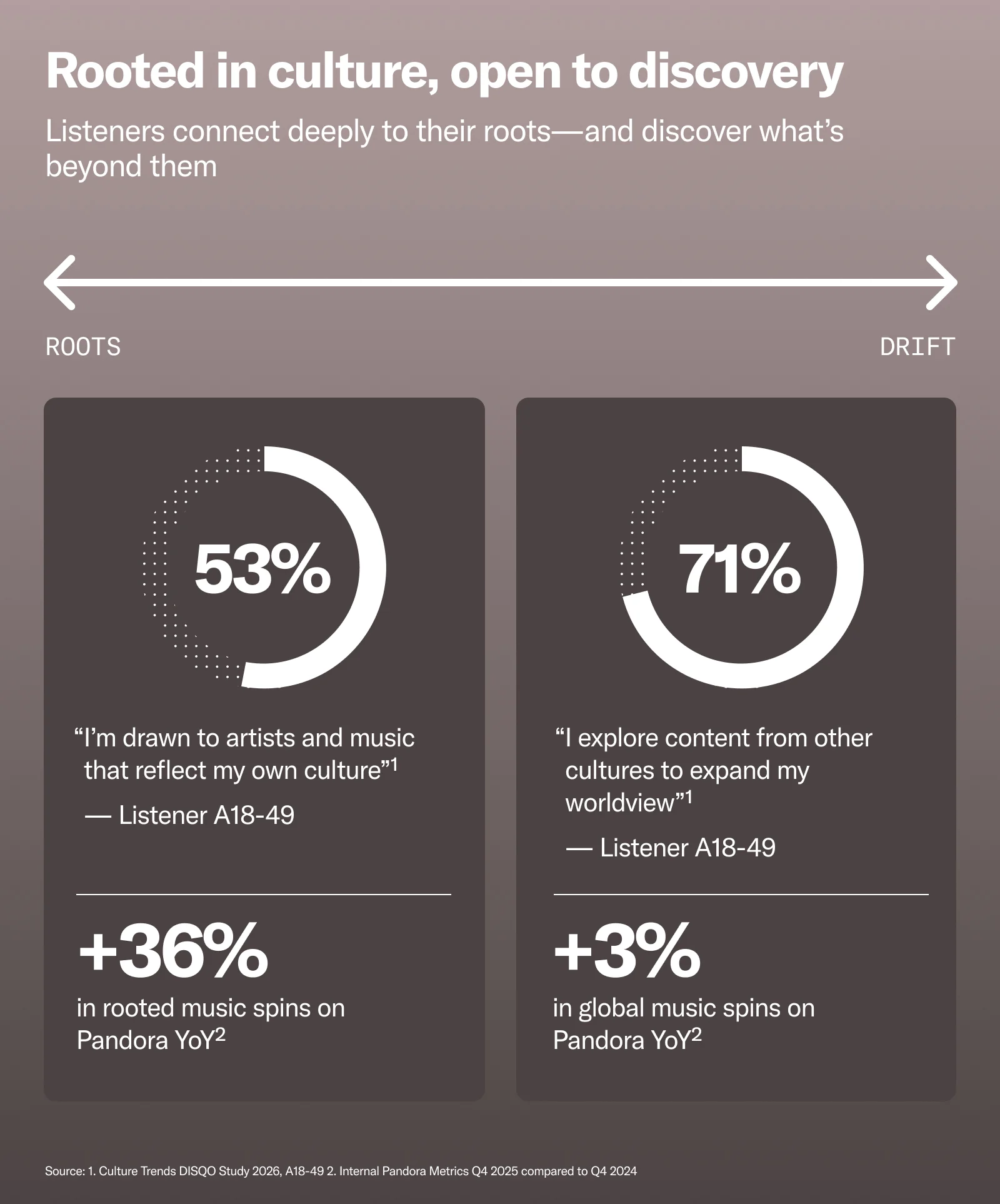
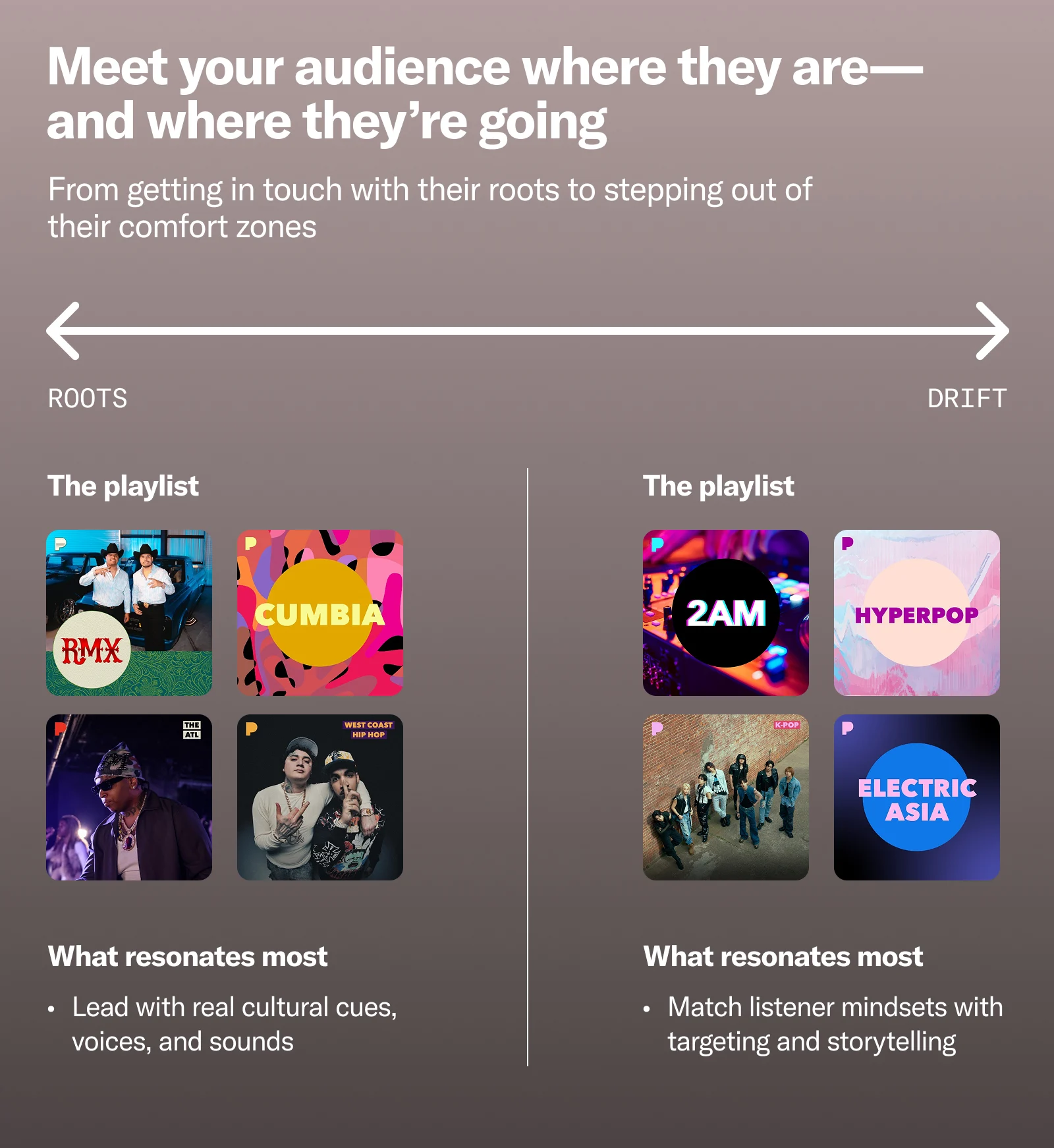
Roots represent one end of the Homedrift spectrum, with 53% of listeners saying they’re drawn to artists and music that reflect their culture. 2 These listeners are gravitating toward homeland anchor—a category of artists who are reaching back through the generations to tell a story of cultural pride that brings listeners of all backgrounds together. With Latin music being the fastest-growing genre in the US, it’s no surprise that we’re seeing trends in this genre, from a +23% increase in spins for Bad Bunny YoY to a 33% increase in listening time for the baile funk genre. 1 To reach Hispanic listeners, tap into music that reflects their cultural roots and carries them globally with stations like RMX, El Cumbión, and Dembow Dominicana.
Meanwhile, some listeners are tuning in to regional pulse, known as regionally-specific sounds from the rap genre, including Atlanta and LA. This shift solidifies the fact that the pop-ification and mainstreaming of rap is over. Listeners are proving that specificity is supreme. To reach Black listeners, tap into sounds that honor their cultural legacy while pushing it forward with stations like ATL: Atlanta Rap and West Coast Hip Hop.
Drift: Expanding our worldview
On the other end of the Homedrift spectrum is drift, representing 71% of listeners who explore content from other cultures to expand their worldview. 2 This side is proof that listeners don’t need to understand the lyrics of a song or speak the same language as an artist for it to resonate with them. In fact, we’re seeing a +3% boost in global music spins on Pandora YoY. 1 Gen Z is helping lead this charge of genre blurring, from artists to listeners. Gen Z artists have moved beyond the confines of a genre to create unique, experimental music that is resonating with their young listeners. These blurred lines act as a reflection of our continually diversifying cultural landscape. Listeners are expanding their borders, and we’re seeing this on full display with trends like Brazilian Plug seeing an increase in listening time by +49% and plays of Mexican reggaeton being up by 81%. 1 And brands can reach curious listeners with stations like Activados and Satélites.
For others, sounds made for exportation continue to dominate. Listeners are adopting new languages and beats in this fusion, whether it’s learning a K-pop lyric or traveling oceans auditorily with UK hip hop—which has seen a 276% increase in streams. 1 You can find these listeners on stations like K-pop and Electric Asia.
How brands can tap in
Here’s the recipe for success: Specificity builds belonging. In a fragmented cultural landscape, the brands that win are the ones that feel most inviting. Showing up with specificity and care turns moments of listening into moments of belonging—and discovery into connection.
Here’s how to win over listeners:
Plan for emotional states: Map media and creative to moments of grounding and discovery. Reach audiences through content that reflects their identities while also introducing them to new ideas, sounds, and experiences.
Lead with cultural specificity that can travel: Start with real cultural cues, voices, and sounds, then let them scale. Authentic content creates stronger connections over broad, one-size-fits-all messaging.
Use audio as emotional infrastructure: Prioritize formats and executions that feel human and present—affinity targeting, contextual integrations, and storytelling that matches listener mindset. Whether audiences are seeking comfort, pride, curiosity, or expansion, align creative and context with the emotional role audio is playing in that moment.
There’s no place like Home(drift)
In a world where culture is constantly crossing borders, listeners are proving that belonging and exploration aren’t opposites—they’re part of the same journey. Some are seeking sounds that reconnect them to their roots, while others are using audio to discover new perspectives, languages, and communities. Many are doing both.
With audiences moving fluidly between grounding and discovery, audio becomes a powerful way for brands to meet listeners in moments of identity, curiosity, and connection. As culture becomes more global and identities become more layered, the most successful brands will help listeners feel seen, connected, and inspired—wherever they are on the Homedrift spectrum.
Explore the SiriusXM Media Culture Index



Related Insights
 Podcasts
Podcast Picks: Celebrating Hispanic Heritage
Oct 23, 2026 Digital Audio
Why Attention Quality is More Important Than Impression Volume
Oct 21, 2026 Podcasts
Bold Commentary, Big Reach: Stephen A Smith on SiriusXM
Oct 20, 2026 Targeting
Activity Targeting Gets Your Brand Messages in on the Action
Oct 16, 2026
