Inclusive Advertising Is Here to Stay: Learn the Best Practices
The conversation around diversity, equity, and inclusion (DEI) has become increasingly polarized in recent years. Some organizations are quietly scaling back their previous commitments, fearing backlash or navigating uncertain economic waters. Yet, despite the noise and shifting political and economic climates, inclusive marketing is critical.
DEI efforts in the workplace and inclusive marketing are entirely distinct concepts. While DEI focuses on internal culture and representation, inclusive marketing is an external strategy designed to connect with the diverse reality of today's evolving consumer base. But to modern audiences, both play a hand in influencing their attention and dollars. The data is clear on where consumers stand: 75% say that a brand’s diversity and inclusion reputation influences their purchase decisions. 1
In this landscape, audio has emerged as a uniquely powerful medium for brands to engage authentically with diverse audiences. Whether it's through podcasts that amplify underrepresented voices or music that transcends cultures and languages, audio offers an intimate and trusted environment for inclusive storytelling.
What is inclusive advertising?
The goal of inclusive advertising is to authentically represent and connect with a broad spectrum of people. It goes beyond simply placing diverse faces in a campaign. Inclusive advertising involves carefully developing messaging that considers various perspectives, avoids stereotypes, and resonates across different cultures and backgrounds.
Inclusive advertising reflects the real world. It acknowledges that your audience is not a monolith but a vibrant tapestry of races, ethnicities, genders, sexual orientations, ages, and abilities. Authentic inclusion means integrating these perspectives into the fabric of your storytelling, ensuring that everyone feels seen, heard, and valued.
Why is inclusive marketing important?
If the moral argument for better inclusion doesn't move the needle for stakeholders, the economic argument certainly should. The collective purchasing power of diverse communities is staggering. Together, Black, Latino, and AAPI consumers hold an estimated $7T in purchasing power. 2 To break that down further, Black consumers alone are projected to hold $2.1T in spending power by 2026. 3 Ignoring these audience segments is effectively capping your brand's potential growth.
Despite the significant consumer power of diverse audiences, they’re often underserved and underrepresented. In fact, 52% of multicultural consumers report being unsatisfied with how their race and ethnicity are portrayed in advertising. 4
Looking ahead, the future is undeniably diverse. While Gen Z is considered the most diverse generation (from race, to ethnicity, to sexuality), Gen Alpha is expected to surpass them. 5 Brands that fail to build loyalty with these valuable demographics now will struggle to remain relevant in the coming decade.
What are the types of inclusive advertising?
A successful inclusive advertising strategy recognizes that "diverse" is not a single category. Campaigns should be tailored based on the specific audience you are targeting, though a single campaign can certainly reach multiple groups. The key is to approach each consumer base with nuance and personalization.
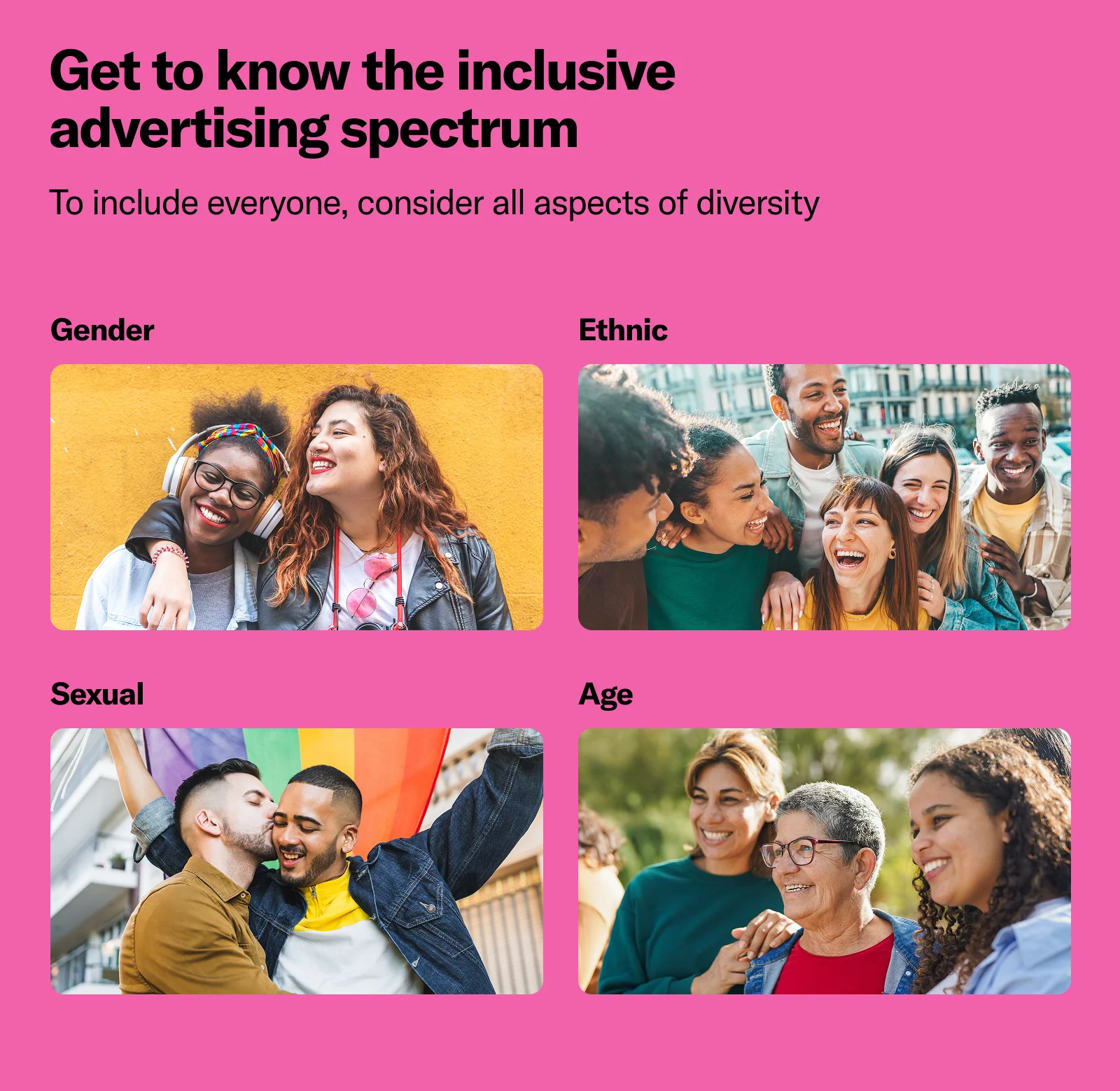
Gender diversity
Women control the majority of consumer spending, yet they are often typecast in advertising more in the US than the global average and frequently portrayed in domestic and family roles. 6 Inclusive advertising challenges these tropes, representing women in all their complexity—as leaders, athletes, creators, and decision-makers—rather than reverting to outdated domestic stereotypes.
Ethnic diversity
Multicultural marketing requires cultural competence and a deep understanding of cultural differences and values. This means creating content that speaks to consumers’ varied experiences, traditions, and aspirations in a way that feels genuine.
Sexual diversity
The LGBTQ+ community is a powerful force in media consumption. Gen Z is the queerest generation in history, and they expect brands to support them year-round, not just during Pride Month. 7 Audio is a particularly strong medium to reach them; podcasts have become a haven for queer voices, bringing listeners closer to their community.
Age diversity
People of all ages want to see themselves reflected in advertising. Marketing often fixates on youth, but inclusive advertising also values older demographics. Age-inclusive marketing challenges stereotypes about both younger and older generations and recognizes the diversity of experiences within every age group, from Gen Z to baby boomers.
Adopt these best practices for inclusive advertising
Getting inclusive advertising right requires a thoughtful and strategic approach. Here are six best practices to guide your efforts.
Understand the difference between DEI and multicultural marketing
First, it’s essential to distinguish between DEI efforts and multicultural marketing. As we mentioned earlier, DEI refers to internal policies regarding hiring and workplace culture. Meanwhile, multicultural marketing is an external growth strategy to connect with diverse consumers.
DEI and multicultural marketing can work in tandem. DEI strengthens multicultural marketing by ensuring diverse voices are at the table. And multicultural marketing enhances DEI by surfacing audience insights that inform more inclusive policies and priorities.
Leverage audience targeting
Audience precision is key. Lean on our advanced targeting solutions like language (English and Spanish), multicultural affinity, genre and music stations, and more to reach your ideal audiences. This ensures your campaign budget is spent reaching the people most likely to resonate with your culturally specific messaging, rather than diluting the impact across a general audience.
Tap into platform targeting
Context is king in audio. You can reach diverse listeners by targeting specific platforms, music genres and stations, or podcast networks. For instance, Audiomack is a hub for hip hop music lovers. Over nine in 10 (94%) of the platform’s listeners are multicultural, with 75% of the audience being African American. 8 Meanwhile, SoundCloud is a powerhouse for young listeners, with 52% of users being Gen Z. 9
Use AI responsibly
Artificial intelligence offers exciting efficiencies and innovation, but it carries risks when used for inclusive advertising. AI models are trained on existing data, which often contains historical biases. By maintaining human touch throughout the creative process, you can prevent AI from reinforcing negative stereotypes or excluding certain groups.
Connect with diverse consumers offline
The digital space is powerful, but face-to-face connection builds deep loyalty. Take your brand offline by sponsoring or participating in events geared toward diverse consumers. For example, our franchise events like El Pulso and HBCU Homecoming provide tangible touchpoints to engage with diverse communities in a celebratory environment—boosting purchase consideration and creating positive brand associations.
As others pull back, push forward
While some competitors may retreat from multicultural marketing due to the "anti-DEI" climate, this is your moment to lean in. Consistency builds trust. By maintaining your investment in diverse communities when others leave, you demonstrate genuine commitment—a quality that consumers reward with long-term loyalty.
Targeting multicultural and LGBTQ+ audio streamers for a health advertiser
Inclusive advertising works; consider this past campaign for a State Department of Health advertiser. The goal of the campaign was to build awareness of teen mental health and drive affinity and engagement among specific target demographics.
Take a look at the diverse solutions used:
Product mix: The campaign leveraged a mix of Streaming Select mobile audio and XP placements
Audience targeting: The campaign specifically targeted audio streamers in the advertiser’s state, focusing on Hispanic, Black American, American Indian, and LGBTQ+ consumers
Creative messaging: To ensure the ads resonated among multicultural consumers, the campaign utilized a mix of English-language and Spanish-language creatives, delivering informative and emotional brand messaging
Here were the results, driven by the SiriusXM Streaming Network campaign: 10
4.3M impressions (101% impression delivery)
+647 total clicks
0.19% click-through rate (CTR)
This success story highlights how combining audio advertising, precise audience targeting, and culturally relevant creative can effectively engage diverse communities on critical topics like mental health.
Get started with SiriusXM Media
The data is clear: Diverse audiences are the future of business growth. Whether you are looking to reach Gen Z listeners on SoundCloud, hip-hop fans on Audiomack, or podcast enthusiasts on the SiriusXM Podcast Network, audio is the most effective medium to make (and strengthen) those connections.
Don't let the current climate stall your growth. Let’s talk.
More inclusive advertising insights to bookmark


Related Insights
 Success Stories
SiriusXM Drives Cross-Funnel Lifts for a Breakfast Brand
Oct 12, 2026 Podcasts
Why Podcast Listeners Matter in the AI Era
Oct 12, 2026 Digital Audio
Why Fragmented Consumer Attention is Changing Media Buying
Oct 12, 2026 Targeting
What's the Vibe? How Mood Targeting Improves Your Ad Timing.
Oct 8, 2026
