Why Consumer Memory Matters in Advertising
Explore the role of consumer memory in advertising, from building brand awareness and recall to influencing purchase decisions long after ad exposure.
Consumer memory bridges the gap between your ad and the checkout counter. An ad might last just a few seconds, but the influence it has on consumers can extend well beyond that moment.
As shoppers move through the buying journey, what they remember about your brand can help shape their decisions. It’s the rare consumer who brings an ad or product comparison chart to the grocery store aisle. And while shoppers can look up information on their phones in seconds, many purchase decisions still come down to what feels familiar or stands out in the moment, whether they're looking at a shelf, menu, or showroom floor. Since your ad may only last a matter of seconds and the purchase itself only takes a minute, your customers’ memories may do most of the work during the buying journey.
If your brand isn’t top of mind when one is ready to buy, you risk missing out on consideration. Consumers don't always remember an ad after hearing it just once. Instead, brand familiarity often builds through repeated exposures across channels. The real job of advertising is to build mental availability, making your brand easier to recognize and recall when a relevant need arises.
Clicks, impressions, and other engagement metrics can tell advertisers how audiences interact with campaigns, but they don't always capture what consumers remember. And that memory can play an important role in future purchase decisions. Audio is particularly well-suited to building lasting brand associations, using sound, storytelling, and repetition to help messages stick long after an ad ends.
Why consumer memory plays a critical role in advertising effectiveness
Audio has a unique way of engaging the imagination and creating lasting brand associations. Unlike visual media, which often shows audiences exactly what to picture, audio invites listeners to draw on their own memories and experiences to bring a message to life, known as “theater of the mind.”
For instance, a description of a truck can’t paint the entire picture the same way a description of a meal cannot fully elicit a taste. That’s the job of memory and imagination. Through sound, storytelling, and familiar voices, listeners can picture themselves in a scene, making the message feel more personal and memorable.
Memory influences decision-making
Attention is temporary. Someone can be fully tuned in for thirty seconds and remember very little an hour later, which is why an ad’s primary job is often to create and reinforce brand memories rather than drive immediate action. What consumers remember can influence which brands they recognize, consider, and ultimately choose. And different formats can help reinforce those memories in different ways. Among video podcast viewers, 23% agree that seeing a product or brand in a video podcast makes it more memorable. 1
Memory compounds over time through repeated exposures
Repetition can help reinforce a message, making it easier for consumers to recognize and recall a brand over time. In fact, research has shown that brand awareness can continue to build after more than four ad exposures. 2 Upper-funnel advertising, then, isn’t disconnected from conversion. By building familiarity and strengthening brand recall, awareness campaigns can help lay the groundwork for future consideration and purchase decisions.
Audio combines repetition with emotion
Sound is processed quickly by the brain, and familiar sounds can trigger memories and emotional associations. But hearing a message once doesn't guarantee it'll stick. Repeated exposure, especially when paired with meaningful storytelling, music, or recognizable sonic cues, can help strengthen those associations over time. For advertisers, this creates opportunities to make their brands more memorable long after an audio ad ends.
How brand recall influences consumer decision-making long after exposure
A purchase doesn’t always follow an ad immediately. Sometimes, it happens days, weeks, or even months later, making it important for brands to consider longer measurement windows. In a past durability experiment, we found that 18% of all conversions occurred three weeks after the campaign, 3while separate research has found that brand recall effects can persist for up to four months after a campaign ends. 4
Streaming audio and podcasts can keep brands top of mind across that stretch because they fit naturally into consumers’ daily routines. Digital audio listeners spend over four hours a day with digital audio, accompanying the commute, the workout, the dishes, and the walk. 5That’s a lot of chances to reinforce a brand familiarity and strengthen recall through repeated exposure.
Where the touchpoint lands matters just as much as how often it occurs. Advertising within trusted content environments can help brands build connections that go beyond impression volume. In fact, audiences feel podcasts are 2.5x more trustworthy than social media, 6 and roughly 40% of ad-supported audio listeners can recall hearing an audio ad in their day. 7 When a familiar podcast host delivers a brand message, that established relationship with listeners can help make the ad feel more credible, relevant, and memorable.
Why immediate engagement metrics do not tell the full performance story
Engagement in advertising has quietly become shorthand for whatever can be counted right away: the click, the like, the completed view. Those numbers can reveal how consumers respond to ads in the moment, but they don't necessarily capture how advertising influences brand perception or future purchasing behavior. This is especially true for audio, which often reaches consumers when they're multitasking or away from screens. Nearly 80% of all audio listening happens when visual media isn’t an option. 8 A listener driving to work can’t tap an ad. But that doesn't mean the message isn't making an impression.
And as consumer search behaviors evolve, clicks are becoming an increasingly incomplete measure of advertising impact. With the rise of AI search overviews, zero-click search results are cutting traffic to publishers and brands. These trends highlight why advertisers need to look beyond direct clicks to understand how campaigns influence consumer interest and downstream actions.
That's where consumer memory comes in. While clicks capture immediate engagement, brand recall helps advertisers understand whether their message sticks beyond the initial exposure. And unlike a click, remembering a brand doesn't require consumers to stop what they're doing or interact with a screen. By measuring both immediate responses and longer-term outcomes like brand awareness, recall, consideration, and purchase intent, advertisers can get a more complete picture of campaign effectiveness.
What brands can learn from memory-based advertising measurement
Think of your campaign as a series of opportunities to build brand familiarity rather than a single ask. Repeated exposure can help reinforce brand messages and strengthen long-term recall, and a few creative choices can make each exposure more memorable.
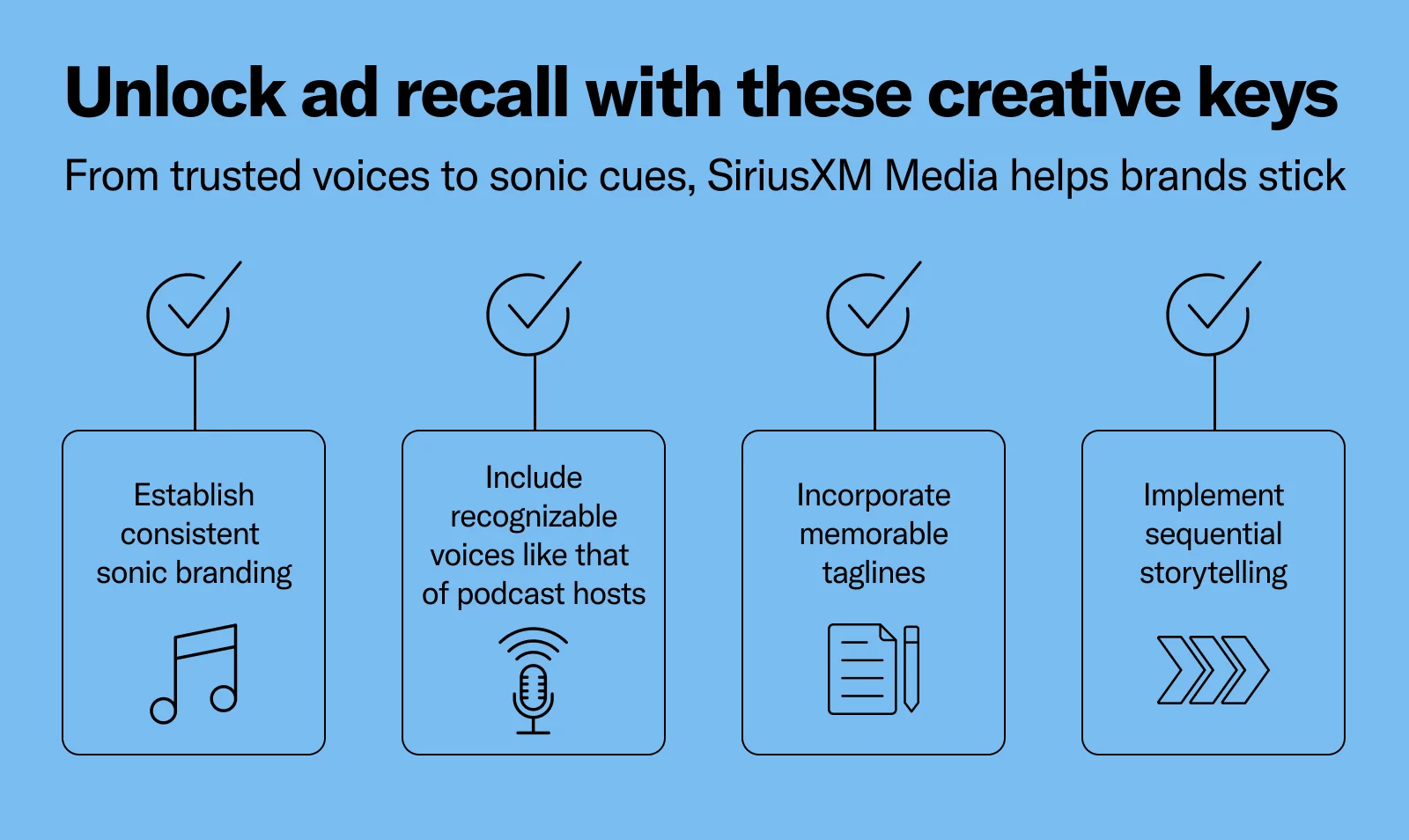
Consistent sonic branding: A recognizable cue can trigger brand recognition before the copy even begins. From jingles to audio logos, sonic brand cues help establish a distinctive identity that listeners can associate with your brand across campaigns and platforms.
Recognizable voices: 60% of podcast listeners say they pay more attention to ads voiced by the host. 1 Pacing and tone carry brand personality the way a color palette does, so the voice you pick is more than a casting decision. It's an opportunity to build familiarity, credibility, and a consistent brand identity.
Memorable taglines and consistent brand naming: Reinforce your brand name throughout the ad, including at key moments like the opening and closing. Pair it with a memorable tagline and consistent messaging to help listeners recognize and recall your brand across different touchpoints.
Sequential storytelling: Instead of running one spot five times, consider building a story across multiple ads through sequential audio: Build intrigue first, add product detail second, and weave in a call to action last. And remember, each spot should still stand on its own for the listener who missed the others.
Measuring the impact of these strategies means looking beyond immediate engagement to understand what consumers remember.
Create advertising strategies that strengthen consumer memory
The brands consumers remember are often the brands they choose. And building that familiarity takes more than a single impression. Through consistent messaging, memorable creative, and repeated exposure, advertisers can strengthen brand recall when purchase decisions happen.
SiriusXM Media helps advertisers build those lasting connections through premium audio experiences that keep brands top of mind long after the ad ends. Let’s chat.