How Audio Supports Full-Funnel Marketing Beyond Clicks
Discover how audio advertising drives full-funnel marketing results beyond clicks, from brand awareness and consideration to conversions and measurable campaign impact.
Click-through rates (CTR) made sense when digital advertising largely centered on screens. But audio has always played by different rules.
Yet many advertisers still evaluate audio campaigns using metrics built primarily for display and social. The result? Audio's contribution can get underreported. Budget decisions may be made on incomplete data. And brands risk missing a channel that reaches audiences during moments when screens aren’t part of the experience.
When someone listens to a podcast during their commute or streams music while cooking dinner, they're not necessarily in a position to click anything. They're listening. And that listening moment—often screen-free and emotionally engaged—can influence how they think about your brand long before they ever visit your website. The challenge for modern advertisers isn't just measuring immediate responses, it’s understanding how audio contributes to outcomes beyond the click. Here’s the good news: Today's audio measurement tools can help advertisers capture the full scope of an ad campaign's impact. From brand awareness to purchase behavior, audio advertising contributes meaningfully at every stage of the funnel. You just need to know which metrics to look for.
What metrics replace click-through rates in audio campaigns?
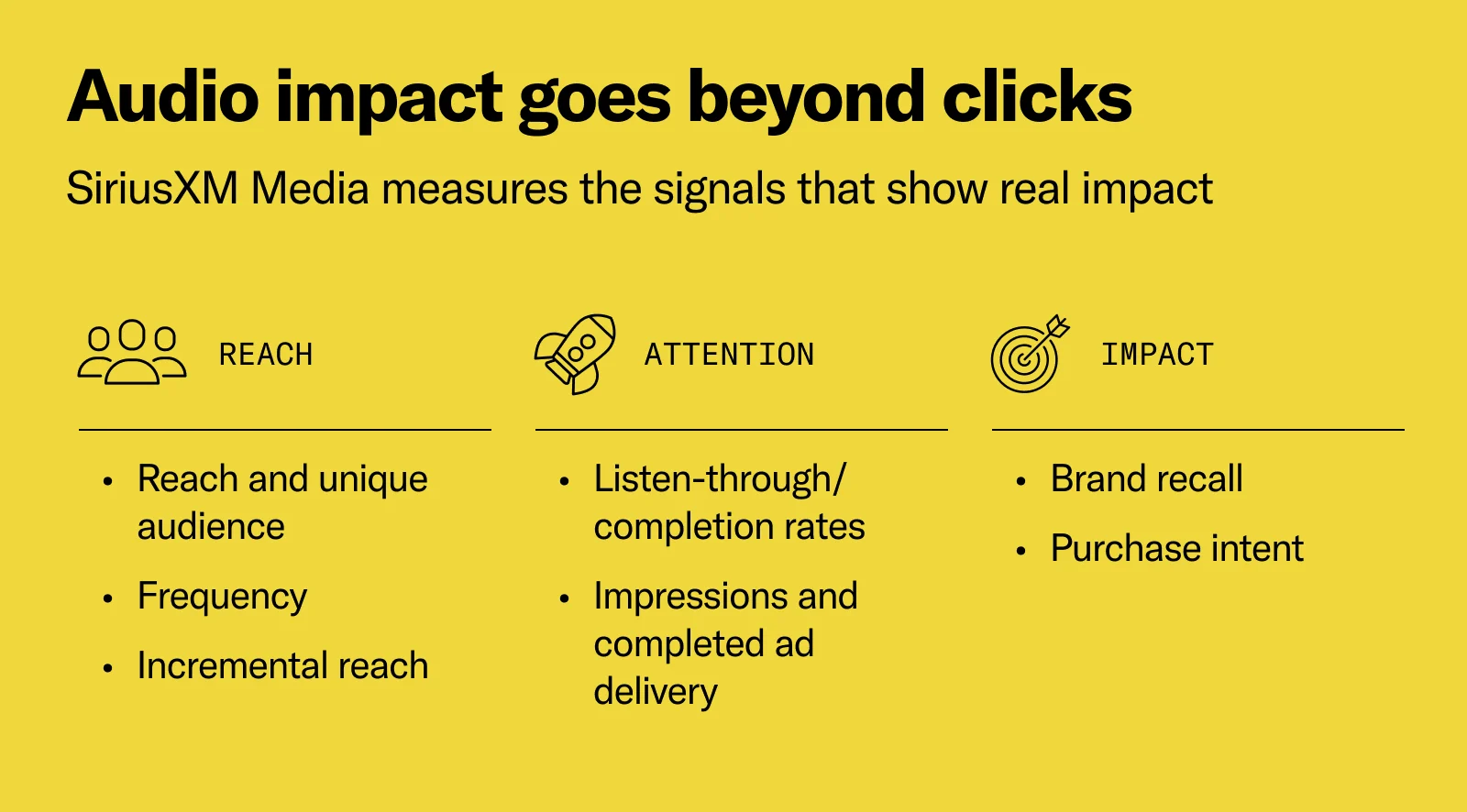
CTR measures one specific behavior: a user tapping or clicking on an ad. That behavior requires an opportunity to interact with a clickable ad, typically on a screen. Audio often reaches listeners when they’re not looking at a screen—which is precisely what makes it powerful for reaching audiences during everyday moments without visual clutter, and precisely why CTR can be an incomplete measure of audio campaign success. The right approach is to match metrics to campaign goals. A brand running an awareness push has different success criteria than one driving purchase consideration. And brands can employ audio tactics that encourage and track clicks for mid- and lower-funnel goals. Here's a breakdown of the metrics that help advertisers measure audio performance.
Reach and unique audience
Reach tells you how many distinct people were exposed to your message. For brand-building campaigns, this is the starting point—understanding the scale of your exposure and whether you're reaching new audiences or repeatedly reaching the same listeners.
Impressions and completed ad delivery
Impressions tell you how often an ad was served. Completed ad delivery goes further, confirming the ad ran in full. Together, these metrics help validate ad delivery and identify whether the message had an opportunity to be heard, rather than being skipped or cut short.
Listen-through/completion rates
A completed listen is a meaningful delivery and potential engagement signal. When a listener doesn't skip an ad, it indicates that they had the opportunity to hear the full message. And that’s a stronger indicator of ad exposure than an impression alone.
Frequency
How often a unique listener is exposed to your ad within a given period can influence recall and brand awareness. We’ve found that brand awareness peaks after more than four ad exposures. 1 Frequency data helps you find that sweet spot between reinforcing your message. Too low, and the message may not stick. Too high, and ad fatigue can set in. Frequency data helps you dial in the right cadence.
Incremental reach
Incremental reach measures the additional, unique audience reached by adding a specific channel or platform to a campaign. This metric is especially valuable for understanding how audio extends the reach of a broader media mix. Because SiriusXM Media's streaming audio and podcast audiences have minimal overlap, combining formats can help brands reach additional, unduplicated listeners. Adding streaming audio and podcasts to a SiriusXM campaign, for example, delivers +142% incremental reach. 2
Brand recall
Sound can play a powerful role in long-term memory. Brand recall, often measured through surveys comparing exposed and unexposed audiences, helps assess whether listeners remember the brand after hearing an ad. Audio ads have been shown to produce 50% more attention than benchmarks across video, TV, and social media. 3That attention can help strengthen brand recall. And it's one of the clearest indicators of whether audio is doing its upper-funnel job.
Purchase intent
Purchase intent measures consumers’ reported likelihood of making a purchase, often assessed through brand lift studies. Streaming audio listening habits can also provide behavioral signals that help advertisers identify audiences more likely to take action. For instance, 56% of Pandora listeners have taken an action after hearing a streaming audio ad, whether it’s searching for a product, visiting a website, or looking up a promo code. 4 While these actions don't directly measure purchase intent, they demonstrate how audio can encourage consumer engagement beyond the initial ad exposure. Purchase intent metrics help advertisers understand how audio influences consideration and consumers' likelihood to buy.
How audio influences awareness, consideration, and conversion
Audio's reputation as an upper-funnel channel undersells its actual capabilities. Streaming audio and podcasts can influence consumers at every stage of the purchase journey.
Awareness
At the top of the funnel, audio excels at introducing brands to new audiences. Nearly 80% of all audio listening occurs when visual media is unavailable, which means audio reaches consumers during moments when they may not be engaging with display, social, and video. 5 Repeated exposure can build familiarity. And that familiarity can strengthen with multiple ad exposures. Premium listening environments, from music streaming to podcast content, offer opportunities to capture attention and make first impressions stick.
Consideration
The middle of the funnel is where many advertisers underestimate audio. Once a listener knows your brand, audio keeps it top of mind throughout longer purchase cycles. Podcasts are particularly effective here: Audiences rate podcasts as 2.5x more trustworthy than social media. 1 When a trusted host discusses or endorses a product, that message can carry added credibility. Reinforcing messaging across both streaming audio and podcast environments helps brands stay present through the consideration phase.
Conversion
Audio may not always serve as the final click before a purchase, but it can contribute meaningfully to the multi-touch journey that leads there. Streaming audio targeting capabilities can help advertisers reach audiences based on their interests, listening behaviors, and relevant contexts, delivering messaging that can encourage downstream search behavior, site visits, and eventual purchases. The conversion doesn't always trace back to the audio ad directly, which is why measurement and attribution models need to account for audio's role across the broader customer journey.
How to measure brand lift and engagement in audio advertising
Brand lift studies give advertisers a structured way to quantify the impact of audio campaigns on consumer perception. These studies typically compare survey responses from exposed and unexposed audiences to measure shifts across several dimensions.
Brand awareness: Are people exposed to the campaign more likely to recognize the brand?
Ad recall: Are exposed listeners more likely to remember hearing the ad?
Message association: Did the campaign successfully link the brand to a specific message or attribute?
Brand favorability: Did perception of the brand improve?
Purchase consideration: Are exposed listeners more likely to consider buying the product?
Purchase intent: Did the campaign increase listeners’ reported likelihood of making a purchase?
Brand lift complements performance metrics by capturing influence that doesn't show up in clicks or conversions. A campaign might drive strong completion rates and incremental reach, but brand lift studies help determine whether those exposures actually shifted consumer perceptions and attitudes.
Beyond brand lift, engagement signals matter, too. Attention quality, not just exposure volume, can influence downstream outcomes. Audio ads have the opportunity to capture attention during immersive listening experiences, including moments when consumers aren’t looking at a screen. Completion rates, exposure frequency, and listening context all contribute to a richer picture of campaign effectiveness.
Measure campaign impact with SiriusXM Media
Modern audio advertising is measurable, precise, and an important part of a full-funnel marketing strategy. From incremental reach to brand lift, today’s measurement solutions help brands demonstrate audio's value at every stage of the customer journey, not just in the moments consumers tap a screen. SiriusXM Media reaches 255M listeners monthly across streaming audio, podcasts, and SiriusXM satellite radio. 6 With first-party data, advanced targeting, and comprehensive measurement capabilities, SiriusXM Media helps brands connect audio investments and measure campaign performance to meaningful business outcomes.
Ready to build an audio strategy that goes beyond the click? Let’s chat.
Read next


Related Insights
 Podcasts
The Unwell Network’s Big Year Means Big Wins for Brands
Nov 6, 2026 Digital Audio
How Audio Supports Full-Funnel Marketing Beyond Clicks
Nov 6, 2026 Digital Audio
How Advertising Strategies Adapt to Consumer Media Habits
Nov 5, 2026 Success Stories
SiriusXM Takes an Airline Brand's Campaign Beyond Game Day
Nov 3, 2026
