Why Media Diversification is Becoming Essential for Advertising Strategies
Learn why media diversification is essential for modern advertising strategies and how audio can expand reach, reduce channel dependency, and improve campaign resilience.
Consumer attention has never been more scattered. Today, audiences move fluidly between social feeds, streaming services, podcasts, connected TV, and other media throughout the day—often within a matter of hours. For advertisers, that fragmentation is more than just a challenge to manage. It's a signal to rethink how media budgets get allocated.
As audiences divide their time across more platforms and content experiences, relying too heavily on a small number of channels can make it harder to build consistent reach—and leave campaigns more dependent on changes within individual platforms.
As media habits continue to evolve, media diversification—the practice of spreading advertising investment across multiple channels and formats—has become an increasingly important part of building effective campaigns. Audio can play an important role in that mix. By adding listening moments to a broader media strategy, advertisers can create additional opportunities to reach audiences and reinforce messages delivered across other channels.
Why channel concentration creates advertising risk
Channel concentration happens when you allocate a large share of a media budget to a single platform or a small number of channels. While concentrating spend can simplify campaign planning and buying, it can also create greater dependency on the performance, audience, and capabilities of those channels. Diversifying across channels reduces that dependency and means no single platform update can destabilize your entire media strategy.
Platform changes can affect performance
Digital platforms routinely update their algorithms, bidding structures, and targeting capabilities. A campaign that performs well one quarter can see meaningful performance dips the next. It’s not always because the creative or audience strategy changed, but because the platform did.
Audio channels, by contrast, deliver consistent performance in environments where algorithmic volatility can be less of a factor. Digital audio, including streaming audio and podcasts, operates in environments that are structurally different from social media and display platforms. The channel reaches consumers in screen-free moments like during commutes, workouts, and household tasks. That distinction makes audio a natural complement to screen-based channels rather than a substitute for them.
Audience saturation can limit performance
When a brand repeatedly serves the same message through the same channel, ad fatigue can set in. The potential risks include drops in engagement and a decline in completion rates. Media habits also change over time as consumers adopt new platforms, devices, and content experiences. Diversifying across channels can help advertisers avoid becoming overly dependent on where audiences spend their time today and create a media strategy that can adapt as those behaviors evolve.
Channel concentration can limit incremental reach
Repeatedly targeting the same audience across the same channel doesn't always generate new demand. Incremental reach refers to the additional, unique audience exposed to a campaign through a new channel.
That’s where audio can complement an existing media plan. Streaming audio and podcasts can reach consumers across different content experiences and moments throughout the day, giving advertisers opportunities to connect with audiences beyond their existing screen-based placements. Adding audio to an existing campaign with video, social, or display can unlock meaningful new reach rather than simply duplicating impressions.
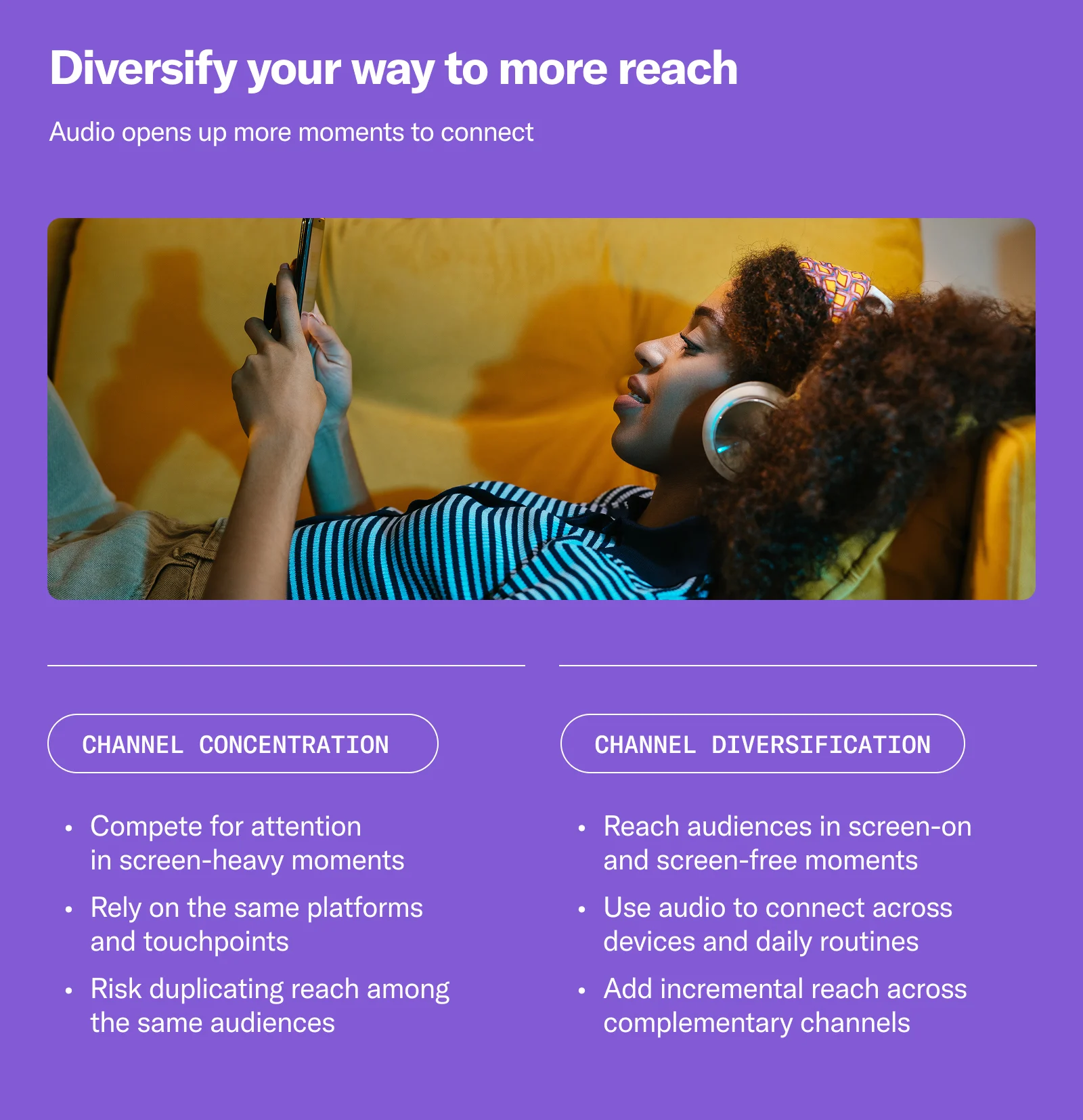
How consumer attention is driving media diversification
Consumer media habits span many platforms, devices, and moments throughout the day. A routine might involve a podcast during a morning run, music during a work session, social media at lunch, and a streaming TV show after dinner. These aren't separate media behaviors; they're a continuous, fluid pattern of attention that moves between screen and screenless moments.
Media diversification matters. A media plan concentrated primarily in screen-based channels may miss opportunities to connect during moments when consumers aren't actively looking at a screen. Someone driving to work, cooking dinner, exercising, or doing household chores may not be scrolling through a feed or watching video—but audio can still fit naturally into the activity. Audio fills the gaps that screens leave behind, creating a channel that remains consistently accessible regardless of what else the consumer is doing.
What media buyers should consider when expanding channel mixes
Adding more channels to a campaign doesn’t automatically create a stronger media mix. A smarter approach starts with audience and campaign objectives, followed by identifying the channels and formats best suited to accomplishing them.
Begin by understanding where your target audience spends time throughout their daily routines and how your existing media plan reaches them. From there, evaluate potential channels based on factors like incremental reach, measurement, brand safety, and creative fit.
Reach vs. frequency
One of the goals of media diversification is to connect with consumers who may not already be seeing your ads. Before adding more frequency among audiences already exposed to a campaign, consider whether another channel could extend the campaign to incremental audiences.
Look at audience overlap across channels and platforms to understand how much incremental reach a new investment could provide. For instance, SiriusXM Media's podcast network has virtually no overlap with SoundCloud, Pandora, and SiriusXM, meaning combining our platforms generates pure incremental reach.
Measurement capabilities
Every channel added to a media mix should have the ability to measure performance accurately, whether it’s reach and frequency, brand lifts, or sales. For brands expanding into audio, measurement partners and methodologies can help connect ad exposure to business outcomes beyond impression, providing a more complete view of the channel’s contribution.
Brand safety and suitability
Diversifying your media mix brings exposure to new content and inventory environments, making brand safety and suitability important considerations. Podcast advertising, for instance, requires advertisers to consider the tone, topics, and context surrounding an ad placement. Establishing brand safety and suitability criteria before scaling into new digital channels can help advertisers identify environments that align with their individual brand standards and campaign objectives.
Creative fit
Different channels demand different creative formats and approaches. Audio ads need to work without relying on visuals. Display ads need to convey a message at a glance. Video ads require combining sight, sound, and motion to tell a story. A diversified media plan is only effective if the creative is adapted (not just repurposed) for each format. For audio, that could mean using voice, music, sound effects, or sonic branding to create a message designed specifically for the listening experience.
How diversified media plans improve campaign resilience
Media diversification can make campaigns more adaptable when conditions change, be it a platform algorithm update, shift in consumer behavior, or economic pressures.
Reduced dependence on a single platform
When a large share of campaign delivery depends on one platform, changes to its audience, pricing, targeting capabilities, or performance can have an outsized effect on the overall campaign.
A diversified media mix spreads that exposure across multiple channels. If performance changes in one area, advertisers have other channels available to maintain reach, adjust investment, and continue working toward campaign objectives.
More opportunities to maintain reach as consumer behaviors change
Consumer habits continuously shift. And they're evolving faster than ever. Platforms that commanded attention five years ago may not have the same influence today. Similarly, a channel that delivers strong results today may underperform in 18 months. A diversified media plan is built to adapt, because it isn't wholly dependent on any single platform for results.
Greater flexibility to optimize budget
A diversified media mix also gives advertisers more options when optimizing campaign investment. As performance data becomes available, media buyers can evaluate how individual channels are contributing to campaign objectives and adjust budgets when appropriate.
Over time, measuring performance across channels can also help advertisers better understand the role each one plays within the broader media mix—and use those insights to inform future planning.
Build diversified media strategies with SiriusXM Media
SiriusXM Media connects advertisers with 255M monthly listeners across Pandora, SoundCloud, the SiriusXM Podcast Network, and SiriusXM. 1 And with partnerships with companies like Innovid and VideoAmp, advertisers can play and measure their audio campaign alongside other channels. For brands looking to reduce channel dependency, expand incremental reach, and show up in screen-free moments, audio is an instrumental part of any media plan.
Ready to build a more full-coverage media strategy? Let’s chat.
More audio advertising insights


Related Insights
 Podcasts
Serialously and 10 to Life Join SiriusXM Media: Meet Annie Elise
Oct 6, 2026 Digital Audio
Why Media Diversification is Becoming Essential for Advertising Strategies
Oct 5, 2026 Success Stories
A Sports Drink Brand Scores with Football Fans on SiriusXM
Oct 5, 2026 Success Stories
The Mel Robbins Podcast Drives Sales for a Personal Care Brand
Oct 1, 2026
