How Audio Ads Influence Decision-Making Without Direct Responses
Audio ads drive results beyond clicks. Learn how streaming audio and podcast advertising build brand awareness, influence purchase decisions, and boost recall.
Not every successful ad ends with a click. That's a hard truth for performance-focused marketers. But measuring advertising success through clicks and immediate conversions captures only a fraction of what's actually happening. Long before a consumer searches for a product, visits a website, or walks into a store, their preferences may already be taking shape. Audio advertising can play an important role in shaping those preferences.
Streaming audio and podcast advertising offer unique advantages compared to visual media. They reach consumers during screen-free moments—commutes, workouts, and wind-down routines—without competing for their visual attention. Through passive listening, repetition, and emotional context, audio can build brand recall and familiarity and influence consumer decision-making long before consumers are ready to make a purchase.
How audio advertising impacts consumer psychology
Brand preferences don't start at the moment of purchase. They can form during the days, weeks, and months leading up to it through repeated exposure, emotional associations, and subtle cues that influence perception without conscious awareness.
Audio can influence emotional and cognitive processing in ways that differ from visual advertising. Sound can move through short-term memory quickly, but when it resonates—when the tone, voice, or music aligns with something meaningful—it can encode into long-term memory. Through a process called implicit memory, listeners can develop brand familiarity even without consciously recalling a specific ad.
Familiarity can amplify this effect. Brands that feel familiar are more likely to be recognized, trusted, and considered, even when a consumer cannot pinpoint why. Each streaming audio ad, podcast host read, and recognizable jingle can contribute to that sense of familiarity. And when messages are delivered through trusted voices, like podcast hosts, that credibility can help reinforce positive brand associations.
Why passive listening environments influence brand perception
Audio has a unique ability to reach consumers in moments when visual media may not be accessible. Unlike visual content, which competes for attention on cluttered screens and fragmented feeds, audio fits naturally into everyday life and doesn’t disrupt other activities.
Audio accompanies daily routines
Audio is one of the few advertising channels that can follow people throughout their day. Listeners tune in while commuting, exercising, cooking, working, and winding down. In fact, over 90% of listeners 18 and up consume streaming audio weekly or more often—from home (84%), to the car (72%), to at work (44%). 1
These everyday listening environments create opportunities for brands to connect with consumers as they go about their routines. Audio ads that are delivered in these moments don't feel like interruptions. They feel like part of the experience.
Visual media is cluttered and fragmented
Every time a consumer opens a social feed or loads a webpage, they encounter dozens of competing visual stimuli. Consumers may scroll past, skip, or ignore these ads as they navigate content. Meanwhile, audio doesn't face the same resistance. Because it doesn't require visual attention, it can reach consumers without competing with the screens they’re already using. In fact, audio ads produce more than 50% greater attention compared to benchmarks across video, TV, and social media. 2
Contextual listening environments create positive brand associations
Mood and activity targeting in digital audio allow brands to align their messages with how a listener is actually feeling and what they’re doing in the moment. Pandora's mood targeting capabilities, for example, let advertisers reach listeners who are relaxed, celebratory, energized, or focused (and much more) in real time.
When a brand's message arrives during a meaningful moment—a morning run, a creative work session, an evening wind-down—that emotional context can help shape how the brand is perceived. By aligning messaging, tone, and creative with the listening experience, advertisers can build relevant associations even when listeners aren't actively considering a purchase.
How do repetition and sonic familiarity shape purchase consideration?
Sound not only makes an impression, but it’s also a strong memory trigger, and that combination drives consideration. Hearing something once may not be enough to make a lasting impression. But hearing it again (and again) in the right context, with the right sound, can build something more powerful: familiarity. From a well-placed audio logo to a consistent brand voice, the sounds associated with your brand can reinforce memory and build recognition that influences purchase consideration.
Repeated exposure strengthens memory
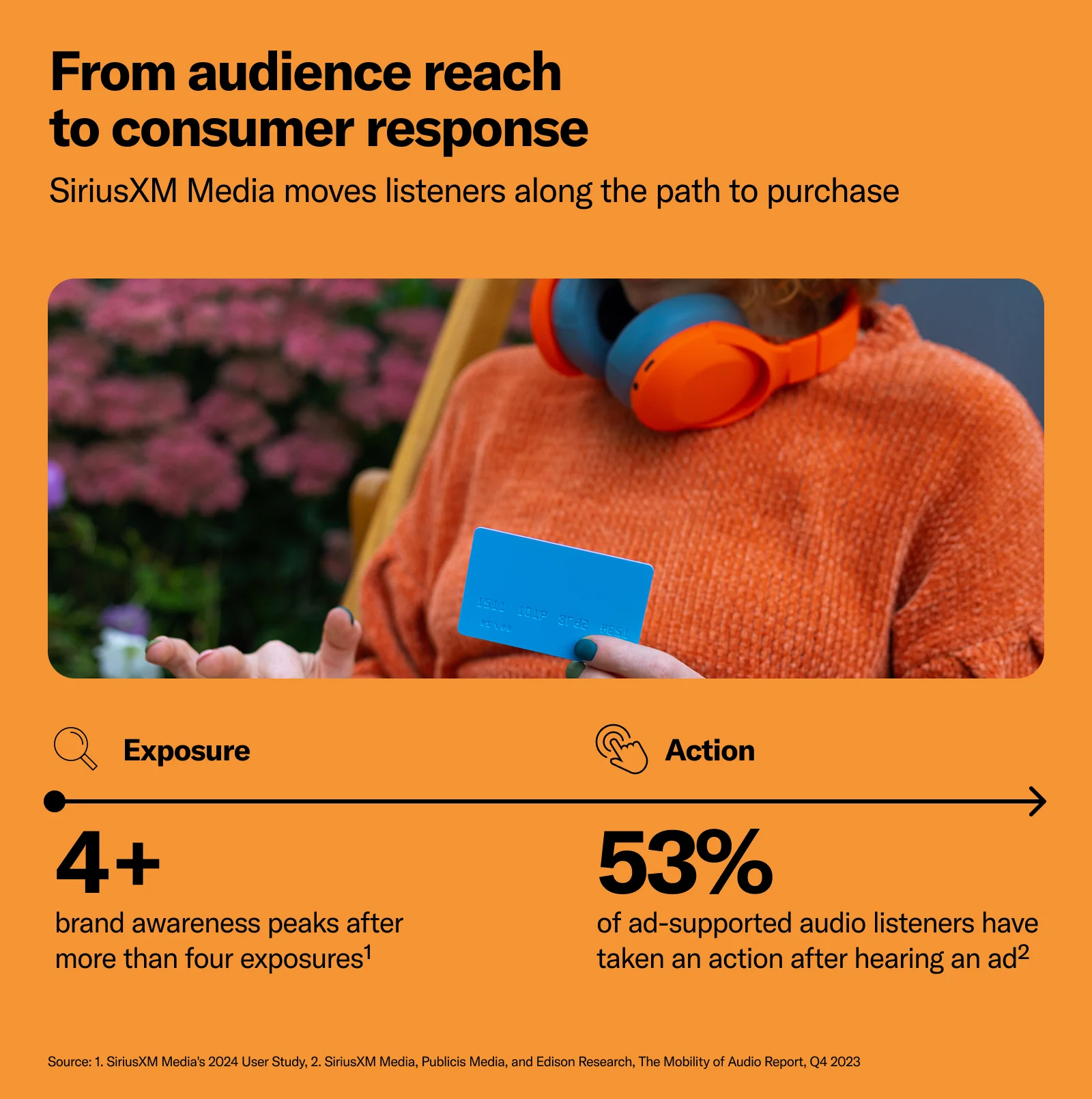
Repetition is fundamental to how audio builds brand memory. We’ve found that brand awareness peaks after more than four ad exposures. 3 But frequency alone isn't the full story; how a brand repeats its message matters just as much.
Campaigns that rotate ad lengths generate a median of 20% incremental reach. 4 Sequential audio advertising—where each ad builds on the last rather than repeating it—can help maintain listener interest while reinforcing the brand narrative. Together, these approaches create opportunities to strengthen recall while reducing the risk of ad fatigue from running a single creative on a loop.
Sonic branding boosts familiarity
Audio logos, jingles, consistent voice talent, and signature soundscapes all contribute to a brand's sonic identity. It’s no coincidence that one third of young adults favor brands with a recognizable sound. Because sound can evoke memory and emotion, a distinctive sonic identity can create recognition that extends beyond any single campaign. When a consumer hears a familiar audio cue, they don't just remember the ad—they remember the feeling associated with the brand.
The role of emotional context in audio advertising effectiveness
Emotion doesn't just make ads more engaging. It also makes them more persuasive, more memorable, and more likely to drive long-term brand preference. Audio is uniquely suited to delivering emotional resonance and helping brands stand out. Music, pacing, narration, and sound design all work together to shape how a listener experiences an ad. Those feelings can become associated with the brand. For instance, an ad that evokes nostalgia, humor, or warmth during a listener's relaxing evening playlist doesn't just communicate a message—it can create an emotional connection. Emotionally aligned messaging can strengthen brand recall and help messages stay top of mind, increasing the likelihood that consumers remember the brand when considering a purchase.
Why audio advertising works without immediate click-based engagement
Click-through rates don't tell the whole story for audio ads—and relying on them can be misleading. Audio reaches listeners during screen-free moments: commutes, workouts, long drives. Consumers may not be in a position to click, but they are listening and can engage. The impact may show up later by way of a Google search, store visit, or direct website visit days after hearing the ad. Understanding that potential delay is the key to measuring the full impact of audio advertising.
Purchase journeys start early
Many consumer purchases don't happen in a single session. Purchase journeys can span days, weeks, or months, with consumers gathering impressions long before they form an explicit intent to buy. Measuring an audio campaign's success solely by immediate response can overlook its broader value. Audio’s real impact can show up in brand awareness, consideration lift, and downstream behavior like searches, site visits, and in-store decisions.
Audio is a full-funnel channel
Audio advertising can build awareness and trust at the top of the funnel, nurture consideration in the middle, and reinforce purchase intent closer to conversion. In fact, 53% of our ad-supported audio listeners have taken an action after hearing an ad—whether that's searching for a brand, making a purchase, or recommending it to someone else. 5 These behaviors demonstrate how audio can influence consumers beyond the initial ad exposure. Clicks are one metric, but understanding audio’s full impact requires looking at outcomes across the purchase journey.
Reach decision-ready audiences through SiriusXM Media
Audio's influence on consumer decision-making doesn't always start at the search bar. It can start in the car on a Tuesday morning, on the phone during a lunchtime run, or on a laptop with a true crime podcast. By the time a consumer is ready to buy, audio has already done significant work—building familiarity, trust, and emotional connection that makes your brand the obvious choice.
Ready to see what audio can do for your brand? Let’s chat.
Read next



Related Insights
 Digital Audio
How First-Party Data Improves Audio Targeting Without Cookies
Nov 2, 2026 Digital Audio
How Audio Ads Influence Decision-Making Without Direct Responses
Nov 2, 2026 Success Stories
Beyond Awareness: Streaming Audio Drives Auto Sales Lift
Oct 28, 2026 Digital Audio
How Multitasking Consumer Behavior Is Changing Media Engagement
Oct 27, 2026
