How First-Party Data Improves Audio Targeting Without Cookies
Explore how first-party audio data helps advertisers reach the right listeners without third-party cookies while improving engagement, campaign efficiency, and ROI.
Digital advertising is undergoing a massive shift. As consumers become more conscious of how their data is used and privacy protections evolve, third-party cookies and mobile advertising IDs (MAIDs) are becoming less reliable as the foundation for targeting. Brands that previously relied on these external tracking methods to find their ideal customers now face a challenge. They must find new, privacy-conscious ways to deliver relevant messaging without crossing boundaries.
Fortunately, digital audio offers a strong path forward. Streaming audio and podcast platforms generate rich first-party listener data based on direct relationships with listeners. Because listeners log in to access content, engage daily or weekly, and make their preferences known, publishers collect accurate, transparent data signals without relying on third-party identifiers. As the advertising ecosystem becomes more privacy-focused, first-party audio data can help brands maintain precise targeting and personalization while respecting consumer privacy.
What does first-party data mean in audio advertising?
First-party data refers to the information a company collects directly from its users through their interactions with its products, services, and platforms. In the audio space, this data goes far beyond basic demographics. It includes specific listening habits, such as preferred genres and the exact time of day, as well as engagement signals like ad skips and completions.
Because this information comes directly from the listener's relationship with the platform, it doesn’t rely on third-party cookies. Pandora, for example, has over 20 years of logged-in user data. This creates an authenticated environment where listeners are logged in 100% of the time. Today, the platform processes over 1B audience signals daily, building a deeper understanding of who brands are reaching. And because this data comes directly from registered users, Pandora's first-party data is 3.8x more accurate than that of other publishers.
That direct relationship becomes even more valuable as consumers pay closer attention to how companies handle their information. In fact, 71% of users say that they would stop supporting a company that mishandles their sensitive information. 1 Furthermore, 83% of consumers cite data protection as one of the most crucial factors in a company’s ability to earn their trust. 2 For advertisers, first-party data offers a way to balance these expectations with the need for relevant, precise targeting—helping brands connect with the right audiences while taking a more privacy-conscious approach.
How do digital audio platforms use listener data for targeting?
Digital audio platforms can turn first-party listener data and contextual signals into actionable audience insights. By analyzing how people interact with streaming audio and podcasts—from listening behaviors to preferences—advertisers can deploy highly specific campaigns based on interests, habits, and moments.
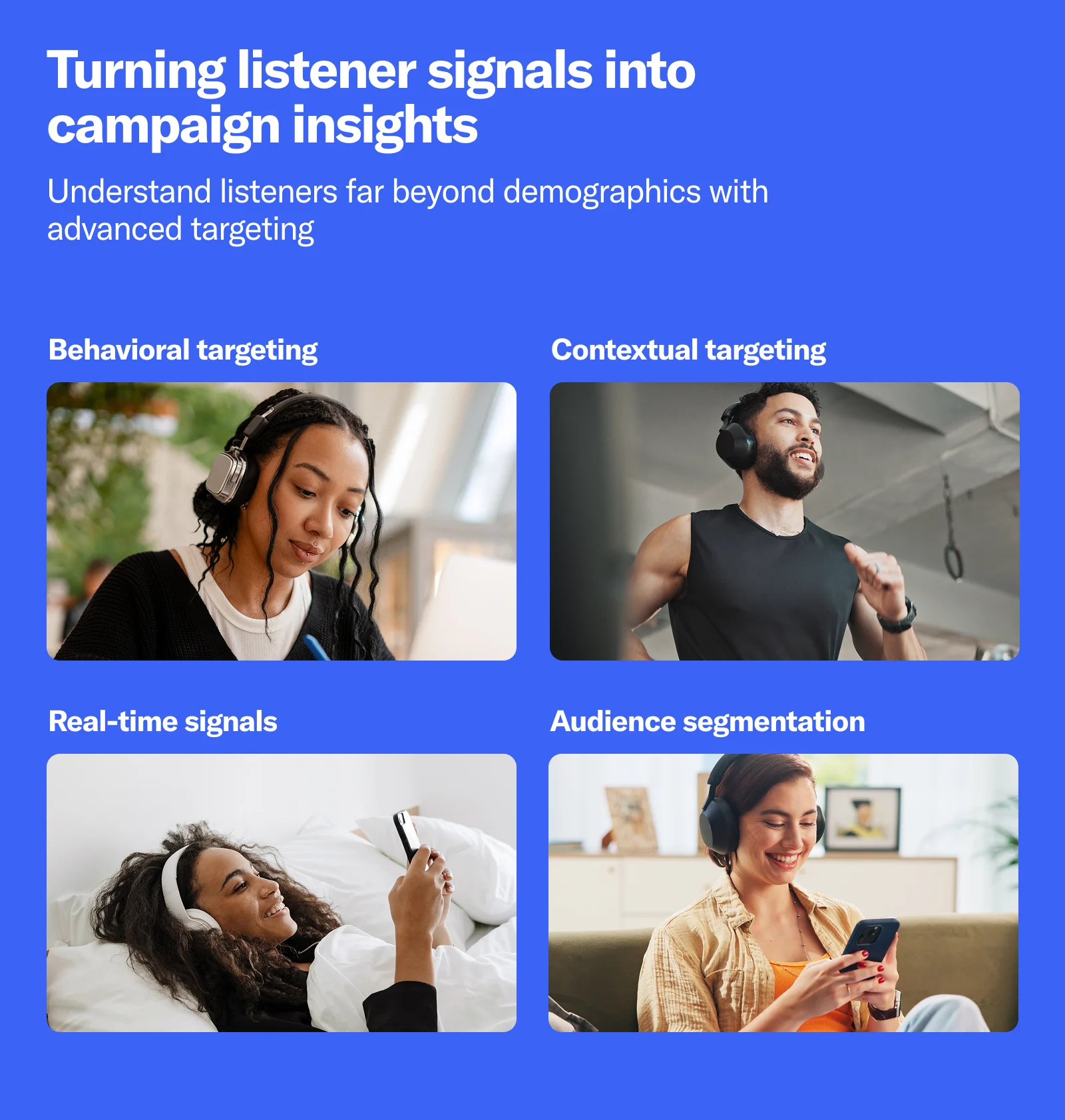
Behavioral targeting
Behavioral targeting analyzes historical listener habits to help identify relevant audiences. For instance, if a listener consistently streams energetic, upbeat playlists during weekday mornings as they get ready, an audio advertising platform may identify this as a predictable behavioral pattern. Brands can align their ads with these established preferences, ensuring their messaging reaches consumers whose everyday habits better match the product or service being offered.
Contextual targeting
Contextual targeting aligns advertisements directly alongside relevant content or environments, capturing the listener's real-time activity and mood. For example, if a user streams a pop playlist while they get ready to go out on a Friday night, brands may serve high-energy ads that match that excited environment and mood. Meanwhile, in the podcast space, technologies like transcription technology and content analysis can help identify episode topics, helping brands place ads alongside contextually relevant content.
Real-time signals
Real-time signals add another layer of relevance by accounting for factors like time of day, device, and location. These signals can help advertisers tailor campaigns to the circumstances surrounding a listening moment—for instance, someone listening to a smart speaker at home in the evening is likely cooking or relaxing, making it an ideal time for dinner delivery ads or wellness messaging. Rather than assuming exactly what a listener is doing, advertisers can use these signals to make messaging more relevant to the moment.
Audience segmentation
Audience segmentation involves building interest-based cohorts from shared characteristics, interests, or behaviors. Rather than targeting a single user, platforms group thousands of users who share similar characteristics. Brands can target segments like "suburban parents who listen to true crime podcasts," delivering highly specific messaging without relying on third-party cookies or a one-size-fits-all approach.
Why first-party audio data is critical in a cookieless environment
As third-party cookies and other traditional identifiers become less central to digital advertising, brands need new ways to understand and reach relevant audiences. Consumers are becoming more conscious of their data and privacy than ever before. They want personalized and relevant experiences, but they also value transparency and control over their data. First-party audio data helps solve this tension. Because streaming audio platforms have direct relationships with their listeners, they can build audience insights from information and behaviors within their own environments—from registration details and declared preferences to listening habits and content affinities. Advertisers can then activate against relevant audience segments without relying as heavily on third-party cookies or cross-site tracking.
Logged-in environments like Pandora strengthen this advantage. When listeners authenticate directly with a platform, publishers can recognize and understand their audiences through persistent first-party relationships rather than depending solely on cookies to connect signals.
How targeted advertising improves campaign efficiency and performance
Transitioning to cookie-free and first-party data doesn’t just solve a compliance issue; it actively improves campaign performance. More relevant audience and contextual signals can also help advertisers use their budgets more efficiently and improve campaign performance.
Reduced waste
Broad campaigns can result in impressions reaching consumers who are less likely to be interested in a brand’s product or service. Meanwhile, more precise targeting helps ensure that ads only reach relevant, high-intent audiences. By prioritizing the listeners most aligned with campaign goals, brands can reduce unnecessary impressions and make their media budgets work harder.
Increased engagement
When an advertisement speaks directly to a user's current mood, context, or preferences, they are more likely to listen. Personalized audio ads drive stronger listener attention because the message feels native to the listening experience. For example, matching the energy of your advertisement to the energy of the music a listener is playing will complement the experience rather than interrupt it.
Frequency optimization
Serving the exact same advertisement to a listener too many times can damage brand perception and cause ad fatigue. First-party data and authenticated environments can help advertisers manage frequency optimization. Cross-device signals can also provide a more complete view of exposure, helping brands deliver the right frequency across a listener’s experience.
Higher conversion potential
Messaging aligned with a listener's mindset and context can boost the chances of higher conversion potential. For instance, if an individual is actively listening to a podcast about personal finance, they may be more receptive to advertisements for finance software or subscriptions. That alignment can create a stronger connection between the advertising message and the listener’s mindset.
Measurable outcomes
First-party data can also strengthen campaign measurement. Audio platforms can provide better attribution using logged-in data signals. Audience and exposure signals can help advertisers connect ad delivery with outcomes such as brand lift, site activity, conversions, and sales, depending on the campaign and measurement solution. These insights give marketers a clearer understanding of performance and opportunities for optimization.
Stronger ROI
When brands combine precise targeting, relevant creative, optimized frequency, and stronger measurement, the result is a more efficient campaign. More efficient spend directly translates to better performance metrics, ultimately working towards a much stronger ROI.
Improve targeting precision with SiriusXM Media
First-party audio data gives advertisers a clearer path forward in a landscape where traditional tracking methods are decreasingly relied on. By leveraging real listener behavior and preferences, device data, and contextual signals across streaming audio and podcasts, brands can reach highly relevant audiences securely.
SiriusXM Media offers the largest ad-supported audience in audio, backed by decades of authenticated user data. Our privacy-first solutions allow you to connect with listeners during key moments and produce more personalized campaigns.
Ready to future-proof your advertising strategy and connect with an engaged, ad-receptive audience? Let’s chat.
More audio advertising insights


Related Insights
 Digital Audio
How First-Party Data Improves Audio Targeting Without Cookies
Nov 2, 2026 Digital Audio
How Audio Ads Influence Decision-Making Without Direct Responses
Nov 2, 2026 Success Stories
Beyond Awareness: Streaming Audio Drives Auto Sales Lift
Oct 28, 2026 Digital Audio
How Multitasking Consumer Behavior Is Changing Media Engagement
Oct 27, 2026
