From Gen Z to Baby Boomers: A Guide to Generational Marketing
Discover how to market across generations with audio, from Gen Z to baby boomers, using audience insights to improve relevance, engagement, and results.
Knowing more about the people you're trying to connect with is one of the greatest advantages in advertising. That context is especially valuable in today’s fragmented media landscape. Each generation has developed its own media habits, brand preferences, and expectations—and audio remains a powerful way to reach listeners across age groups. Layer in factors like financial makeup, life stages, and cultural trends, and you can build a more nuanced picture of your audience—and a stronger foundation for your advertising strategy.
What is generational marketing?
Generational marketing is one of many ways to segment your audience to better understand and connect with them. It groups audiences by generation, using their shared characteristics, experiences, behaviors, and cultural influences as signals that can inform everything from messaging to strategy.
The keyword here is “inform.” Age alone doesn’t tell you what someone cares about, what they’ll buy, or what will make them pay attention. But generational context can help you communicate in ways that feel more relevant. For instance, using modern slang with younger, Gen Z audiences can help get their attention and make them feel seen (as long as it’s nuanced and authentic). Meanwhile, if you use viral slang with an audience of baby boomers, you might catch them off guard or make them feel misunderstood.
When you combine generational insights with audio, you've got a competitive advantage. Different generations may have different listening habits, favorite content, and ways of discovering what’s next, but audio gives advertisers opportunities to reach them throughout their day.
Why generational marketing matters
Today’s brands aren’t always marketing to a single generation. Brands are navigating multi-generational audiences with varying levels of purchasing power, media consumption habits, and expectations. Understanding the differences can help brands make better decisions about where to show up (hint: audio) and what to say.
Consider the economic opportunities of each generation: Gen X is currently considered the largest spending generation and is expected to hold over $30T in spending power by 2050. Meanwhile, by the same time period, Gen Z is expected to hold over $40T in spending power.
How generations interact with brands can differ, too. Baby boomers show significantly more brand loyalty than younger consumers in certain categories, with 76% of them staying loyal to grocery and household goods brands. 1Meanwhile, younger generations are more fluid in their preferences. Remember, the approach that works for one group might fall flat with another.
That’s the risk of one-size-fits-all marketing. The message, media mix, or creative approach that resonates with one generation may miss the mark with another. Generational insights can help brands account for those differences while still leaving room for what makes every consumer an individual.
What are the benefits of generational marketing?
Generational insights give brands another way to understand what makes different audiences tick. When used alongside other audience signals—not instead of them—they can help brands make their messaging and media strategies more relevant, engaging, and efficient.
Improved personalization and relevance
People at different life stages often have different priorities. So, when your message speaks to someone's actual life stage and values, it lands differently. Millennials juggling career advancement and family responsibilities respond to different messaging than Gen Zers still exploring their identities and growing into who they are. Generational insights can help brands account for those differences and create advertising that feels more relevant to the people hearing it.
Higher engagement rates
Relevance can make it easier to earn attention. Understanding how different generations discover content, consume media, and interact with brands can help marketers choose the right message and environment for each audience. And audio adds another advantage. Because streaming audio and podcasts can accompany listeners across activities, moods, and moments throughout the day, brands have opportunities to reach different generations in highly relevant contexts—even when they’re multitasking and screen-free.
Stronger brand loyalty
Building loyalty starts with understanding your audience. Meet people where they are, and they'll remember you for it. When brands consistently show that they understand what their customers value—and communicate in ways that feel authentic rather than stereotypical—they can create stronger connections over time. And audio creates intimate connections, whether through a favorite playlist or a trusted podcast host.
More efficient media spend
Knowing where different generations spend their time can help marketers be more intentional with their budgets. Rather than spreading spend evenly across channels, understanding which platforms and content types resonate with each generation helps you put your budget where it'll actually work.
How to market to each generation with audio
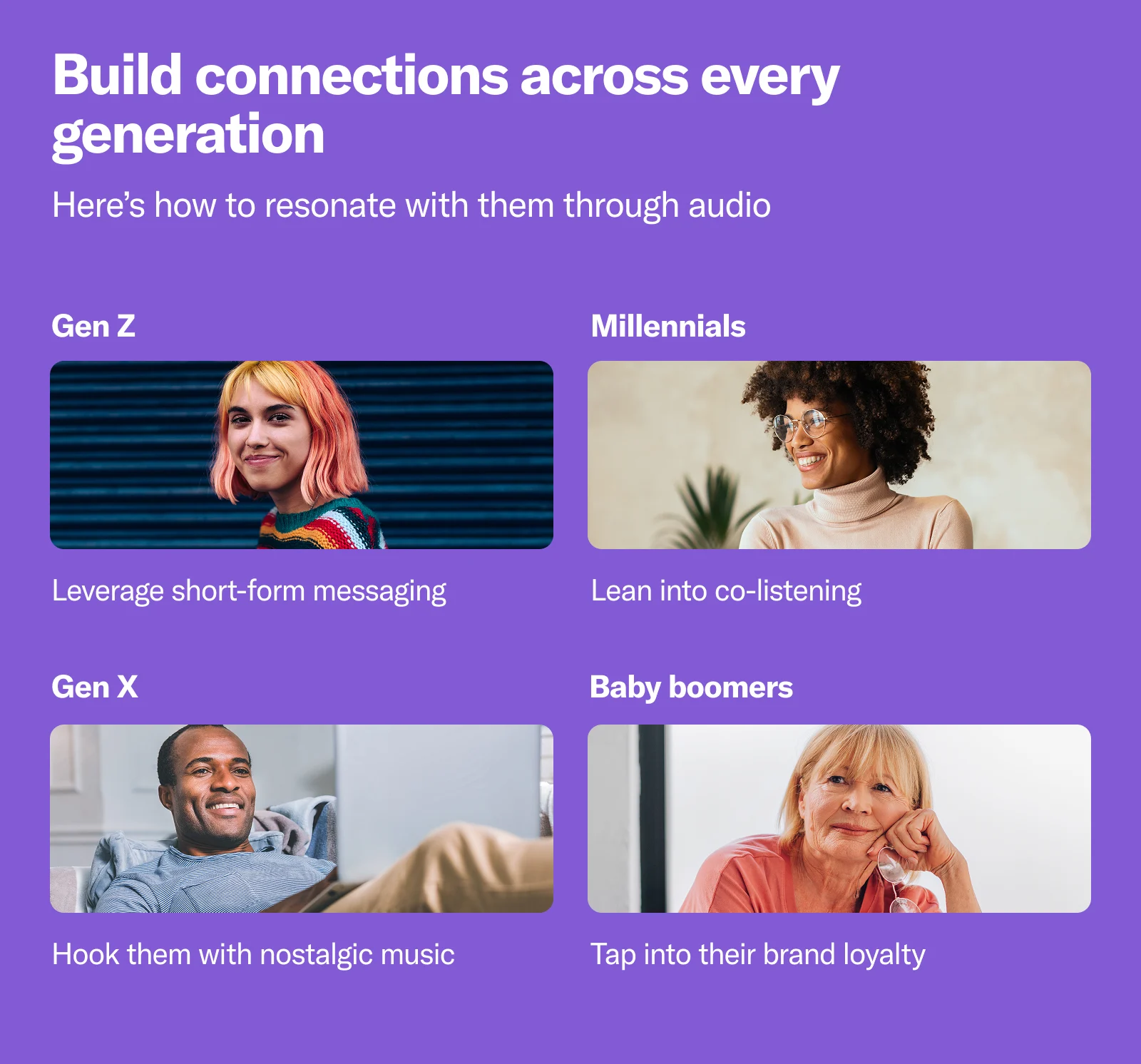
How to reach Gen Z (ages 14-29)
Gen Z has never known a world without the internet—or instant access to endless information and entertainment. That abundance has woven audio into their identity—from how they navigate their lives to express who they are. Among this generation, 82% consider themselves music fans 2 and 97% listened to music in the last month. Audio isn’t just entertainment; it's a mood booster and form of expression. And it’s the number one mood enhancer for Gen Z, and 55% of them say music helps them express their individuality and style. 3
Similarly, podcasts are more than a pastime; it's a medium that adds meaning, with 47% of Gen Z listeners saying that podcasts help them focus on positivity and personal growth. 3 To effectively reach Gen Z, lean into creator-led strategies, short-form messaging, and omnichannel strategies. This generation gravitates toward authentic voices and uses multiple platforms.
How to reach millennials (ages 30-45)
As the largest demographic in the US, millennials are navigating their careers, families, and an increasingly connected life. They're among the earliest generations to come of age alongside digital technology, and this is evident in their usage—this generation owns an average of nearly seven digital devices per person. 4
Through all those devices, audio remains a constant. Two in five millennials say they couldn't get through a day without music. And they enjoy various types: 76% listen to a range of genres and artists. 4 And remember, podcasts are just as important to this generation as music. Over six in 10 (61%) never miss an episode of their favorite show. 5 And speaking of their top content, they enjoy content like Scared to Death, Conan O'Brien Needs a Friend, and The Fantasy Footballers, among others. To properly reach them, align with the personalities and content they spend the most time with.
How to reach Gen X (ages 46-61)
Gen X is currently reigning as the generation with the most spending power. But despite this, adults 55+ receive only 10% of marketing spend. 6 Yet reaching Gen X isn't only about what and how much they buy. It's also about understanding the emotional role audio plays in their lives—and that's where nostalgia comes in. More than 80% of Gen X (82%) say nostalgic music and audio brings them comfort and peace of mind. And 72% of them say that music and audio from their past has shaped their identity. 4 For advertisers, that makes familiar sounds and cultural touchpoints a potentially powerful creative tool.
When it comes to nostalgia, Pandora is the go-to platform. In fact, 84% of Pandora listeners say that nostalgic music brings them comfort and peace of mind, 7 and 71% of Gen X listeners have been consuming Pandora for over six years. 8 Associate your brand with their favorite content, from Subculture: 80s Alternative to 80s Rock Ballads.
How to reach baby boomers (ages 62-80)
While Gen X is known for its spending power, baby boomers are known for their brand loyalty. And once you earn their trust, they tend to stick around. Audio offers plenty of ways to build that trust and loyalty. Despite baby boomers tending to have smaller and quieter households (92% no longer have children living at home with them), they still have the volume on high. 9 In fact, 58% of them listen to streaming audio with their spouse or partner while they’re +35% more likely to say they listen to streaming audio alone, whether it’s 60s Rock or Blues Rock. 8
These preferences give advertisers an opportunity to go beyond age alone. Pandora's contextual targeting can help brands reach baby boomers through listening experiences that align with their interests and the moment.
And music isn't the only way to connect. Baby boomers rely on SiriusXM to stay informed, with 69% saying they trust SiriusXM content and 62% listening to news, business, or political content on the platform—offering another route to reach listeners through the voices and content they already seek out. 10
Delivering multi-generational results for an auto advertiser
An auto advertiser came to SiriusXM Media looking to generate lifts in product awareness, ad recall, and consideration. With our targeting solutions, the brand zeroed in on auto intenders aged 25-54 in key DMAs. Using a combination of Podcast Select and Streaming Select, the campaign proved that audio elevates brand impact. Here’s what was pulled off: 11
+13-pts lift in product awareness among HHI $100K+
+11-pts lift in product awareness among Gen X
+5 pts-lift in product consideration among millennials
+5 pts-lift in ad recall
+4 pts-lift in product consideration among auto intenders
Get started with SiriusXM Media
As you get started, keep this in mind. No one person fits perfectly into a generational marketing persona sheet. No generation is a monolith, and demographic and psychographic trends can only tell you so much about the individual people behind the data. So, be sure to use generational insights as a tool to help you understand your audience—not a shortcut for defining them.
Additionally, generational marketing doesn't mean choosing one audience over another. With audio, you can reach Gen Z on SoundCloud, millennials co-listening during family time, Gen Xers on commutes, and baby boomers enjoying their favorite classics—and everyone, everywhere in between.
Read more generational marketing insights



Related Insights
 Targeting
Activity Targeting Gets Your Brand Messages in on the Action
Oct 16, 2026 Digital Audio
It's Not Too Late to Win New-to-Brand Holiday Buyers with Audio
Oct 15, 2026 Digital Audio
Why Fragmented Consumer Attention is Changing Media Buying
Oct 14, 2026 Success Stories
SiriusXM Drives Cross-Funnel Lifts for a Breakfast Brand
Oct 13, 2026
