Why Fragmented Consumer Attention is Changing Media Buying
Learn how fragmented consumer attention is reshaping media buying and why digital audio helps brands extend reach across screens, platforms, and daily routines.
The media landscape is rapidly changing, and advertisers are adapting to increasingly fragmented consumer attention. Audiences now move between smartphones, connected TVs, social media feeds, streaming services, and other media throughout the day—often engaging with more than one at a time. It reflects a familiar reality—raise a hand if you’ve ever kept a TV show playing in the background while shopping online or scrolling through a social media feed.
In media buying today, consumer attention is marketers’ white whale. Consumers no longer engage with media through a single screen, platform, or even activity. If they are not scrolling their feeds or watching TV at home, they are very likely to be listening to audio in the car, streaming music during a workout, or listening to a podcast while multitasking. Serving an impression is not the challenge—capturing (and keeping) consumer attention is.
That’s where digital audio has a distinct advantage. While visual media competes for consumers’ eyes across an increasingly crowded mix of screens, audio can reach them during both screen-on and screen-free moments. Let’s explore how changing media consumption are reshaping media buying strategies—and why you need digital audio at the center of your strategy.
Why consumer attention is more fragmented than ever across digital channels
The rise of streaming TV, algorithm-driven social feeds, digital audio, and short-form video has changed how consumers interact with media. Audiences jump between devices and platforms throughout the day, carving out highly personalized, non-linear experiences along the way.
Today, everyone can curate their own entertainment, and it’s no longer anchored to one screen or platform—or the living room couch. For advertisers, keeping pace means planning across channels and showing up in the different moments that make up these individualized media journeys.
Digital audio is uniquely suited to move with consumers throughout those journeys. When screens are down or visual attention is elsewhere—think commuting, hitting the gym, or running errands—audio is there, giving brands opportunities to stay connected throughout daily routines.
How multi-device media consumption is changing media buying strategies
Media consumption is no longer sequential
Media consumption has never been completely linear, but today’s multi-device habits make the consumer journey more complex. Today, consumers scroll on smartphones while watching TV shows or move from social media to digital audio, which means your media plan has to account for overlapping channels, devices, and activities where full attention may not be guaranteed. These distractions have always existed (remember running to the bathroom during commercial breaks so you wouldn’t miss a second of your show?). What has changed is the number of devices, platforms, and content options competing for attention throughout the day.
For media buyers, these overlapping behaviors make coordinated, cross-channel media planning increasingly important. Rather than treating each touchpoint in isolation, advertisers need to consider how channels work together to reach consumers across different devices, environments, and moments.
Reach and frequency planning is more complex across channels
When media consumption is spread across many platforms, devices, and formats, managing effective reach and frequency becomes a bigger puzzle. Advertisers can no longer assume that serving an impression means a consumer gave the message their full attention. Even the most captivating TV ad can go unnoticed when a viewer is texting, scrolling, or otherwise focused on a second screen.
At the same time, tracking frequency within individual channels doesn’t necessarily prevent the same consumers from being repeatedly exposed across multiple platforms. A more coordinated media approach can help advertisers understand how each channel contributes to overall and incremental reach, manage frequency across the media mix, reduce unnecessary duplication, and limit ad fatigue.
Why impressions alone aren’t enough to measure advertising effectiveness
Relying too heavily on impression volume as a metric can’t tell advertisers whether their message actually captured attention. An impression tells you an ad was served, but it doesn’t guarantee that someone actually paid attention to it. When marketers prioritize quantity without considering attention quality, they risk spending precious budgets on placements that might get scrolled past, ignored, or tuned out. Screen and ad fatigue are real, and consumers are constantly navigating social feeds, websites, streaming platforms, and other digital environments where ads compete with both content and other distractions for attention.
Digital audio has a distinct advantage in the attention economy since they don’t depend on capturing consumers’ eyes or stopping their scroll. Audio ads drive about 50% more attention than benchmarks across video, TV, social media, and display. 1 Audio ads are also often delivered in lower-clutter environments with a higher SOV, giving brands an opportunity to turn impressions into moments of action.
How brands adapt advertising strategies for fragmented audience behavior
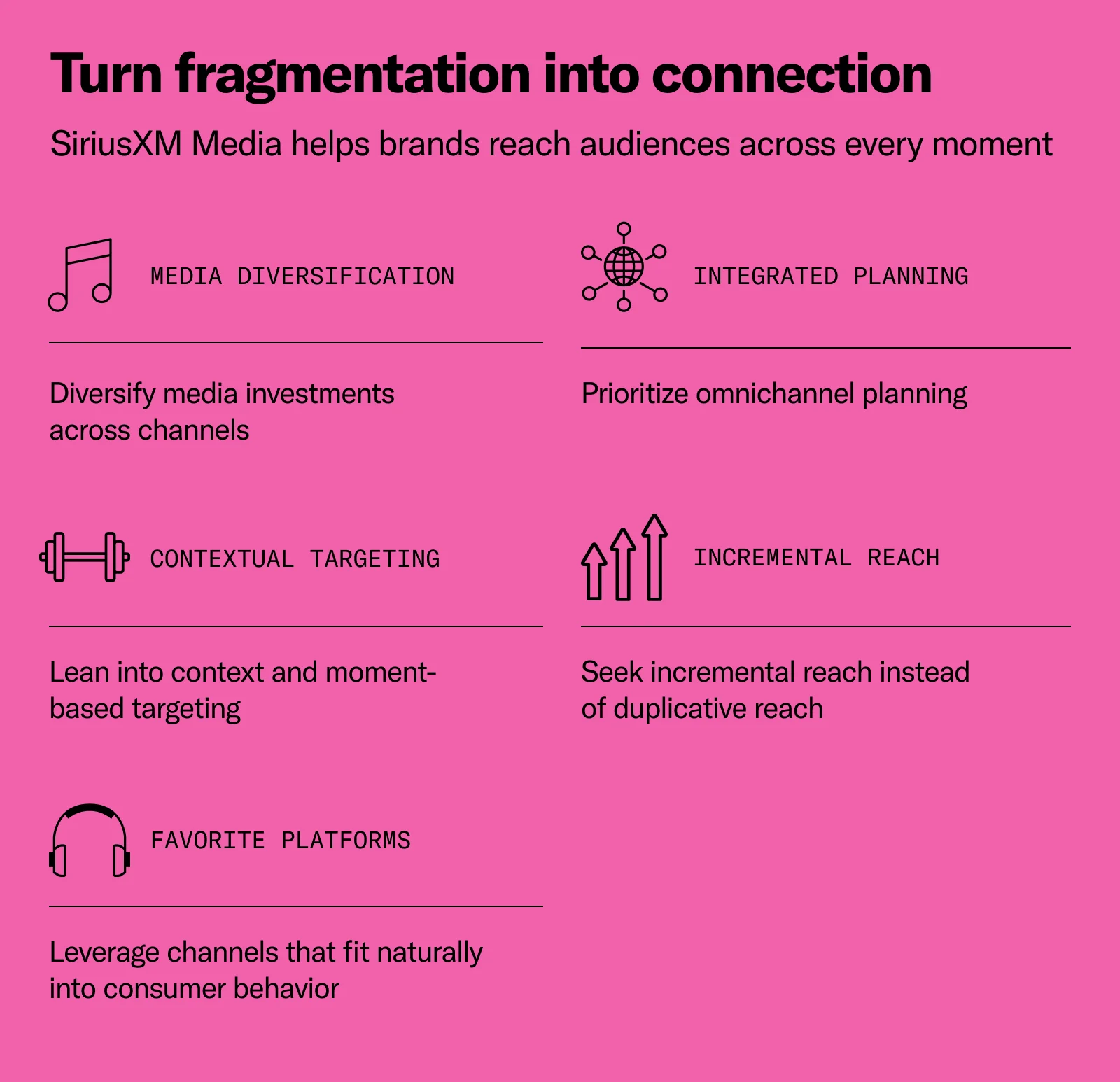
Diversify media investments across channels
To keep pace with fragmented media consumption, your budget has to reflect real-world consumer behavior. Where do they spend most of their time, and where are they the most attentive? For example, consumers spend 21.4% of total media time with audio, yet the medium accounts for only 4.5% of total ad spend in the US. 2Reevaluating your media mix and closing that investment gap is a way to capture lost audience reach.
Prioritize omnichannel planning
As consumers move between platforms and devices, advertisers need a media strategy that moves with them. An omnichannel approach brings digital audio, video, social, display, and other channels together as part of a coordinated media plan. Planning these channels together from the beginning can help advertisers extend reach and reinforce their message across different touchpoints without relying too heavily on any single channel.
Lean into contextual and moment-based targeting
Targeting audience demographics is a starting point, but layering your strategy with contextual insights can make it stronger. Reaching the right person is part of the equation, but advertisers should also consider what they’re listening to, what they’re doing, and when they may be most receptive to a message.
Contextual targeting with digital audio can help advertisers align messages with relevant content, environments, activities, and moments throughout the day. That could mean reaching listeners during a workout, commute, cooking session, or other routine with creatives designed for that particular mindset and moment.
Seek incremental reach
Digital audio can unlock incremental reach by tapping into unique, highly engaged audiences. The channel can complement existing investments by reaching audiences and listening moments that other channels may miss. In fact, adding SiriusXM Media offers incremental reach over other media, up to +29% over streaming TV and TikTok and +26% over linear TV. 3
Leverage channels that fit naturally into consumer behavior
Digital audio fits into daily routines without demanding dedicated screen time. By weaving streaming audio, podcasts, and talk into your media mix, you extend the footprint of your campaigns into moments like driving, exercising, and relaxing, capturing audiences’ attention where display and video ads can’t go.
Adapt cross-channel campaign planning with SiriusXM Media
Modern consumers move across devices, platforms, and environments throughout the day, making cross-channel media planning essential for reaching them in the moments that matter. To get the most out of your campaigns, modern media planning requires reaching audiences across multiple formats and environments.
Digital audio can act as an amplifier, cutting through screen clutter to reach consumers in the moments when other media may not be able to. With SiriusXM Media, advertisers get access to the largest digital audio ecosystem in North America, connecting with 255M monthly listeners. In fact, nine in 10 Americans can be reached across our portfolio as they sing along to their favorite hits or catch up on top podcasts. 4
Ready to level up your cross-channel strategy and meet your audience when they are the most tuned in? Let’s talk.
More audio advertising insights



Related Insights
 Success Stories
SiriusXM Drives Cross-Funnel Lifts for a Breakfast Brand
Oct 12, 2026 Podcasts
Why Podcast Listeners Matter in the AI Era
Oct 12, 2026 Digital Audio
Why Fragmented Consumer Attention is Changing Media Buying
Oct 12, 2026 Targeting
What's the Vibe? How Mood Targeting Improves Your Ad Timing.
Oct 8, 2026
